VOL. 1 · ISSUE 01SEPT 2026
THESPEEDRUN
ISSUE
Beat the clock:
routes, splits & resets
Classified codes
that built a generation
The Power 20:
the greatest games ranked
30
LIVES!
PULL-OUT
POSTER
$4.95 US
PAGE 02CONTENTS
PAGE 03CONTROL MAIL

CONTROL MAIL

The questions we hear most, answered in plain words.

Q. What does “Any%” mean?

It means finish the game any way you can, as fast as you can. No collection requirements, and skips are allowed. 100% means you must collect everything the category lists before the credits roll.

Q. Is a glitch cheating?

Not in a speedrun. A glitch is part of the game’s code, so most leaderboards allow it. Communities that want a purer race run a separate Glitchless category with its own rules.

Q. Why does my old console look blurry on a new TV?

Most classic consoles output a 240p signal that modern TVs were never built to expect. The TV guesses, scales and smears it. An upscaler or a CRT fixes it. See Retro Setup.

Q. What is input lag?

It is the delay between pressing a button and seeing the result on screen. Turn on your TV’s Game Mode, use a wired controller, and skip extra video processing to cut it down.

MORE ANSWERS
EVERY ISSUE
PAGE 04COVER STORY

THE SPEEDRUN ISSUEBEAT THE
CLOCK

A speedrun is a simple promise: start the timer, finish the game, and stop the timer sooner than anyone else. Everything else is craft.

Runners learn a route, the exact path through a game that wastes the fewest seconds. Routes change as players find new skips, faster movement tricks and smarter item orders. A great route is a map of a game that its designers never drew.

Timing comes in two kinds. RTA (real-time attack) is the wall clock from first input to last. IGT (in-game time) uses the game’s own counter. Each leaderboard names which one counts.

Runners split a game into segments and time each one with a split timer, so they know instantly whether a run is ahead or behind their personal best. When a run falls too far behind, they reset and start again. Resets are normal. Most attempts end early.

Charity marathons such as Games Done Quick broadcast runs live for a week at a time and have raised millions of dollars for charity. They are the best place to watch the craft at full speed.

How to start: pick a game you already love, find its leaderboard and rules, watch the top runs, then practice one segment at a time. Speed comes from repetition, not from rushing.

PAGE 05STRATEGY MAP
Isometric pixel dungeon with lava moats, stairways and chests 1 2 3 4 5 6

HOW TO READ
ANY DUNGEON

  1. Find the loop. Most dungeons circle back to the entrance. A door you cannot open yet is a promise, not a wall.
  2. Count the keys. Small keys open one door each. Spend them on doors that lead deeper, not on side rooms.
  3. Watch the floor. Lava, pits and moats mark the routes the designer wants you to cross later, with a new item.
  4. Check the corners. Chests in dead ends usually hold the map, the compass or the dungeon’s item.
  5. Listen for hollow walls. Cracks, odd bricks and a different sound when struck often hide a passage.
  6. Save before the stairs. The big door near the deepest stair is almost always the boss.
PAGE 06CLASSIFIED

CLASSIFIED

TOP SECRET

Codes that built a generation. Every one of these works on the original release.

CONTRA NES · 1988

At the title screen, enter the code and press Start for 30 lives.

↑↑↓↓←→←→BASTART

MORTAL KOMBAT GENESIS · 1993

At the Code of Honor screen, enter this to turn the blood back on.

ABACABB

DOOM PC · 1993

Type during play. IDDQD is god mode. IDKFA gives every weapon, full ammo and all keys.

IDDQDIDKFA

STARCRAFT PC · 1998

Press Enter, type the phrase, press Enter again for 10,000 minerals and 10,000 gas.

SHOW ME THE MONEY

THE SIMS PC · 2000

Open the cheat box with Ctrl+Shift+C, then type the word for 1,000 Simoleons.

ROSEBUD

WARCRAFT III PC · 2002

Press Enter in a single-player game and type this for 500 gold and 500 lumber.

GREEDISGOOD
PAGE 07THE POWER 20

THE
POWER
20

The greatest games ever made, ranked by the Control staff. Now go argue with your friends.
  1. 1Super Mario Bros. 3NES · 1988
  2. 2The Legend of Zelda: A Link to the PastSNES · 1991
  3. 3Tetris1984
  4. 4Super MetroidSNES · 1994
  5. 5Street Fighter IIArcade · 1991
  6. 6Chrono TriggerSNES · 1995
  7. 7Super Mario 64N64 · 1996
  8. 8The Legend of Zelda: Ocarina of TimeN64 · 1998
  9. 9DoomPC · 1993
  10. 10Final Fantasy VISNES · 1994
  11. 11Half-LifePC · 1998
  12. 12Metal Gear SolidPlayStation · 1998
  13. 13Castlevania: Symphony of the NightPlayStation · 1997
  14. 14GoldenEye 007N64 · 1997
  15. 15Pokémon Red and BlueGame Boy · 1996
  16. 16Sonic the Hedgehog 2Genesis · 1992
  17. 17Mega Man 2NES · 1988
  18. 18PortalPC · 2007
  19. 19MinecraftPC · 2011
  20. 20The Legend of Zelda: Breath of the WildSwitch · 2017
PAGE 08HARDWARE
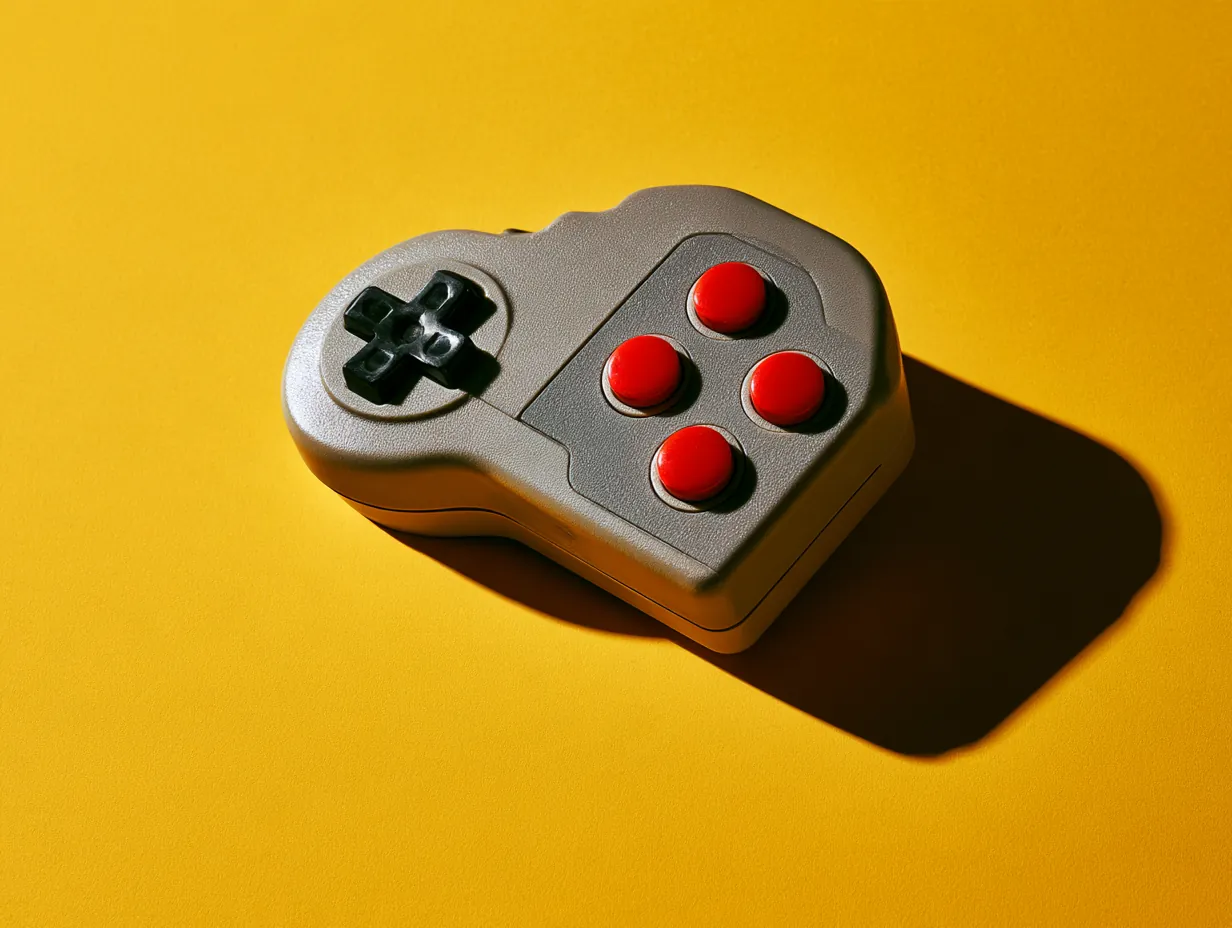
Chunky grey game controller with red buttons on a yellow backdrop

A SHORT HISTORY
OF THE CONTROLLER

  • 1972The first home console ships with dial controllers you turn to steer.
  • 1977The one-button joystick arrives and becomes the symbol of home gaming.
  • 1982Gunpei Yokoi puts a cross-shaped d-pad on a handheld. Every pad since owes it a debt.
  • 1990Shoulder buttons appear, giving your index fingers a job.
  • 1996The analog stick goes mainstream and 3D movement finally feels natural.
  • 1997Rumble arrives. Controllers start talking back.
  • 2006Motion control turns the whole room into the controller.
  • 2020Haptic motors and resistant triggers let a pad feel rain, sand and a bowstring.
PAGE 09ARCADE SPOTLIGHT

ARCADE SPOTLIGHTINSERT
COIN

An arcade is a room full of strangers who all agree on the rules. That is why it still works.

The cabinet is honest. Everyone gets the same machine, the same stick and the same three lives. There is no settings menu and no difficulty slider. The only way to last longer is to play better, and the high score table tells the whole room who did.

Arcades taught a generation to learn by watching. You stood behind the best player in the building, memorized the pattern and waited your turn. Fighting games made that crowd part of the game, with rivals meeting across two sticks on one screen.

PAGE 10RETRO SETUP

OLD GAMES,
NEW SCREENS

A retro gaming desk with a small CRT monitor at dusk
  1. Know your signal. Most classic consoles output 240p. Modern TVs mishandle it, so the picture looks soft and laggy.
  2. Use the best cable. Composite is the worst, S-Video is better, and RGB or component is best. The cable often matters more than the TV.
  3. Add an upscaler. A dedicated upscaler, such as a RetroTINK or an OSSC, converts 240p cleanly to HDMI with almost no delay.
  4. Or find a CRT. A tube TV shows these games the way they were designed, including light-gun games, which only work on CRTs.
  5. Turn on Game Mode. On any flat TV, Game Mode switches off the processing that adds input lag.
  6. Keep the original pad. Wired, original controllers remain the lowest-lag and most accurate choice.
PAGE 11HELP DESK
A 1990s tips hotline office with counselors in headsets

HELP
DESK

Stuck? Ten moves that work in almost any game.

  1. Talk to everyone twice. The second line is often the hint.
  2. Open the map and look for the room you haven’t entered.
  3. Try your newest item on everything.
  4. Strike or blast walls that look different.
  5. Walk away for ten minutes. Fresh eyes solve puzzles.
  6. Go back to an old area with your new ability.
  7. Level up a little before a boss that keeps winning.
  8. Read the item descriptions. Designers hide clues there.
  9. Save in a new slot before any big choice.
  10. Still stuck? Sleep on it. The answer is often obvious in the morning.
PAGE 12BOSS BATTLE BASICS

TECHNIQUEREAD THE
TELL

1 · WATCH FIRST

Spend your first attempt surviving, not attacking. Learn every move the boss has.

2 · FIND THE TELL

Every big attack has a warning: a flash, a sound or a wind-up. React to the tell, not the hit.

3 · PUNISH THE GAP

After a heavy attack, most bosses pause. That opening is your damage window.

4 · RESPECT THE PHASE

At half health many bosses change patterns. Expect it and play safe while you relearn.

PAGE 13PULL-OUT POSTER
Pull-out poster: an orange-suited space pilot facing a colossal robot
PULL-OUT POSTERTHE PILOT AND THE COLOSSUS
PAGE 14NEXT ISSUE
NEXT ISSUETHE HANDHELD
ISSUE

GAME
OVER?

Never. Continue to the next issue.

Publisher
Island Global Co
Web
ctrl.locker
Art
Original illustrations and photography made for Control.

Control is an independent magazine. All game titles are trademarks of their respective owners and are named here for editorial purposes only.

Stage 1Control Sound Test